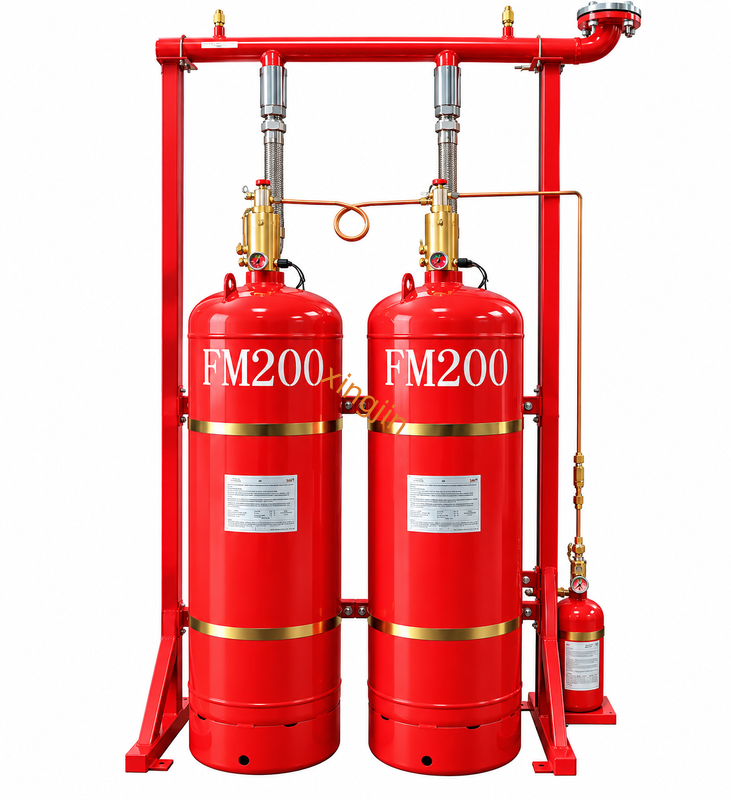
Highlight:
FM200 total flooding system
, 4.2MPa FM200 distribution system
, FM200 system for data centers
Product Definition: The 4.2MPa FM200 Combined Distribution Internal Storage Total Flooding Fire Suppression System is an automatic gas fire suppression system that uses one set of agent storage cylinders to protect multiple protected zones through selector valves. The system adopts an internal storage design, where the agent and driving nitrogen are both stored within the agent cylinder. Selector valves enable precise agent distribution to different protected zones.
Extinguishing Agent / Working Medium: HFC-227ea (FM200), colourless, odourless, low-toxicity, non-conductive, residue-free, with zero ODP. An ideal clean agent alternative to Halon.
Main Functions: Automatic detection, alarm, and total flooding fire suppression for multiple protected zones. When a fire occurs in one zone, the system releases agent only to that zone through the selector valve, achieving precise suppression and avoiding agent waste.
System Positioning: Suitable for centralized protection of multiple adjacent protected zones within the same building, such as multiple server rooms in a data centre, multi-floor electrical rooms, and telecommunication base station clusters. One set of storage cylinders protects up to 8 zones, with agent quantity calculated based on the largest zone. Significant engineering economy compared to unit independent systems.

Technical Specifications
Cylinder Specifications
| Model |
Capacity (L) |
Outer Diameter (mm) |
Height (mm) |
Net Weight (kg) |
| QMP70/4.2 |
70 |
300 |
915 |
53 |
| QMP100/4.2 |
100 |
350 |
1225 |
69 |
| QMP120/4.2 |
120 |
400 |
1425 |
82 |
| QMP150/4.2 |
150 |
400 |
1390 |
104 |
| QMP180/4.2 |
180 |
400 |
1615 |
120 |
Applications
Working Principle
In standby mode, agent cylinders and drive cylinders are closed, and selector valves are shut. When a fire occurs in a protected zone:
-
Fire Detection: Smoke detectors and fixed-temperature heat detectors in the affected zone send fire signals
-
Signal Confirmation: The fire alarm control panel receives the signals. Upon dual-detector confirmation, audible and visual alarms activate, and linked equipment (HVAC, fire dampers) in that zone is shut down
-
Time Delay: The system enters a delay period (0–30 seconds, adjustable) for personnel evacuation
-
Driving Gas Release: After the delay, the control panel outputs DC24V to activate the solenoid valve, releasing high-pressure nitrogen (6.0±1.0MPa) from the drive cylinder
-
Selector Valve Opens: The driving nitrogen travels through the start-up pipeline and first opens the selector valve for the affected zone
-
Container Valve Opens: The driving nitrogen continues and opens the container valve on the agent cylinders
-
Agent Release: FM200 agent, driven by its own pressure and the nitrogen, flows through flexible hoses, liquid check valves, manifold, selector valve, pipe network, and nozzles into the affected zone
-
Total Flooding Suppression: The agent fills the protected zone within 10 seconds, establishing the extinguishing concentration (8%–10%) for total flooding suppression
-
Signal Feedback: The pressure signal feedback device sends a release signal to the control panel, illuminating the discharge indicator
Customization Range
Delivery & Technical Support
-
Lead Time: 15-20 working days for standard configurations; customized configurations confirmed based on specific requirements
-
Packaging: Plywood outer box with cushioning material for safe transport
-
Technical Support: Selection guidance, hydraulic calculation, system design consultation, installation and commissioning guidance
-
After-Sales Service: 24-hour response, 72-hour solution provision
FAQ
Q1: How many protected zones can a combined distribution system protect?
A: Up to 8 protected zones. Agent quantity is calculated based on the largest zone. Each zone must meet the enclosure requirements for total flooding. If more than 8 zones are required, multiple combined distribution systems or unit independent systems are recommended.
Q2: What is the difference between a combined distribution system and a unit independent system?
A: A unit independent system uses one set of storage cylinders to protect one zone, suitable for independent locations. A combined distribution system uses one set of storage cylinders to protect multiple zones through selector valves, suitable for multiple adjacent zones within the same building, offering better engineering economy.
Q3: How does the system ensure agent is released only to the fire-affected zone?
A: The driving nitrogen travels through the start-up pipeline and first opens the selector valve for the affected zone, then opens the agent cylinder container valve. Agent flows through the manifold and selector valve only to the affected zone. Selector valves for other zones remain closed, ensuring zero agent waste.
Q4: What is the difference between internal storage and external storage?
A: In an internal storage system, the agent and driving nitrogen are both stored within the agent cylinder. The system is compact and suitable for conventional protected zones. In an external storage system, the agent cylinder and drive gas cylinder are separate, with the external drive cylinder providing propelling power. Suitable for long-distance delivery and large-space protection.
Q5: How is the system restored after discharge?
A: After discharge, a qualified service provider must replace the drive cylinder sealing diaphragm, re-fill the agent and nitrogen, reset the selector valves and signal feedback devices, and perform full system re-commissioning before the system can be returned to service.


 Your message must be between 20-3,000 characters!