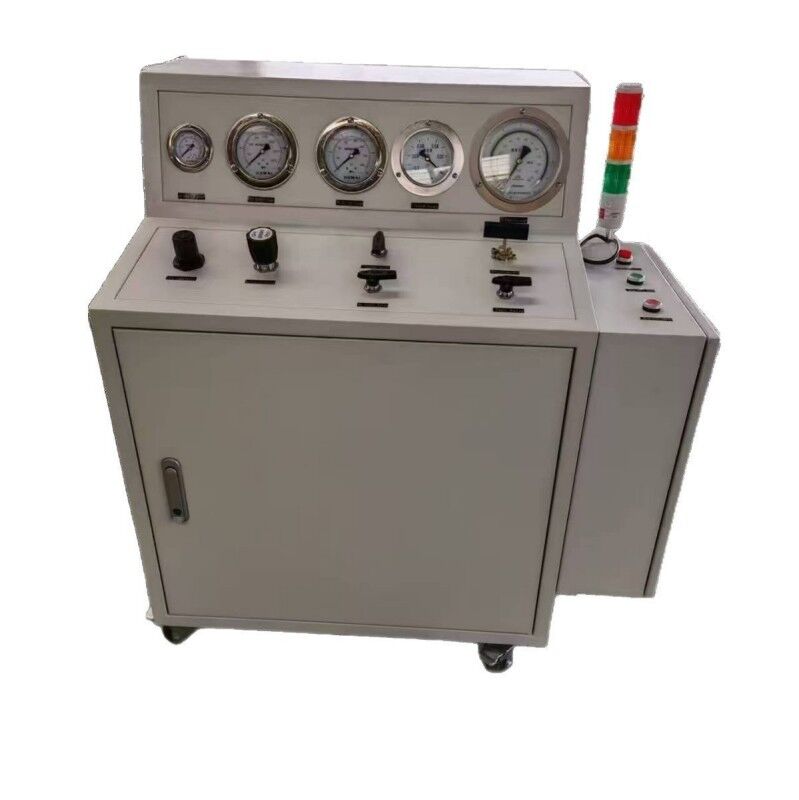
Highlight:
Cylinder Filling Machine
, Novec 1230 Filling Machine
, FM200 Filling Machine
Perfluorohexanone fire extinguishing agent filling equipment
Product Overview:
The Perfluorohexanone (Novec 1230) Fire Extinguishing Agent Filling Equipment is a professional, high-precision, and safe filling system designed for clean agent fire suppression systems. It is widely used by fire protection engineering companies, system integrators, data centers, power plants, petrochemical facilities, telecom rooms, and industrial plants.
The system integrates nitrogen pressure reduction, a filling pressure alarm, a vacuum pumping unit, and a reserved weight alarm interface. It supports multiple cylinder sizes to ensure sealed, stable, and accurate filling performance.
Equipment valve body function:
| F1 Pressure Reducing Valve |
Control the pressure of nitrogen when it enters the system to ensure a stable and safe filling process. |
| F2 pressure relief valve |
Release excess pressure in an emergency to protect equipment and gas cylinders from high pressure damage. |
| F3 Chemical Storage Valve |
Control the flow of fire extinguishing agent from the agent storage tank to the filling cylinder. |
| F4 Nitrogen Storage Valve |
Control the nitrogen gas from the storage tank into the equipment pipeline to provide pressure for filling the fire extinguishing agent. |
| F5 gas cylinder valve |
Used to connect fire extinguishing agent cylinders and control the opening or closing of the cylinder fluid channel. |
| F6 Vacuum Valve |
Used to open or close the extraction of air from the gas cylinder to reduce the pressure inside the cylinder and ensure the purity of the fire extinguishing agent. |
| F7 valve |
Control the flow of perfluorohexanone into the gas cylinder |
| F8 valve |
Controlled access to gas cylinders |
| F9 valve |
Control the passage of nitrogen into the gas cylinder and provide pressure for the gas cylinder. |
Key Advantages
| Feature |
Benefit |
| High Filling Accuracy (±0.5%) |
Ensures consistent agent weight and minimizes human error |
| Maximum Filling Pressure: 5.6 MPa |
Fully meets FM200 fire suppression system pressure requirements |
| Vacuum Pumping System (≤ -0.09 MPa) |
Removes residual air before filling to improve agent purity and system reliability |
| Automatic Pressure Alarm |
Provides real-time warning at preset pressure for safe operation |
| Multi-Cylinder Compatibility |
Suitable for various cylinder capacities in engineering and factory applications |
| Stable Pressure Control |
Adjustable nitrogen pressure reduction range from 0 to 10 MPa |
Typical Applications
-
Data center fire protection
-
Power industry fire suppression systems
-
Petrochemical facilities
-
Telecom equipment rooms
-
Marine and offshore fire suppression systems
-
Fire equipment manufacturers and maintenance providers
Heptafluoropropane filling operation:
Step 1 – Initial Setup and Nitrogen Filling
After the cylinder is valved, move it to the filling room. Secure the cylinder and connect the piping between the cylinder and the filling station. Adjust the electric contact pressure gauge alarm and the pressure reducing valve outlet pressure. Open the cylinder container valve, then slowly open the nitrogen valve to fill with nitrogen. Control the pressure increase rate to no more than 1 MPa per minute until the pressure reaches the specified maximum operating pressure (refer to the Test Pressure Comparison Table). Close the cylinder container valve and move the cylinder to the pressure test room for a cylinder seal test.
Step 2 – Vacuum Evacuation
After the cylinder passes the seal test, move it to the platform scale in the filling room. Secure the cylinder and connect the piping. Open the cylinder container valve, then open the pressure relief valve to relieve pressure. After pressure relief is complete, activate the vacuum function and open the vacuum valve. Start the vacuum pump to evacuate the cylinder. When the pressure gauge approaches -0.09 MPa and stabilizes, close the vacuum valve and stop the vacuum pump.
| Volume |
8L-30L |
40L |
70L |
90L |
100L |
120L |
150L |
180L |
| Minimum vacuum time |
30s |
40S |
50S |
56S |
60S |
65S |
78S |
93S |
Step 3 – Dew Point Control
Adjust the electric contact pressure gauge and pressure relief valve outlet pressure to 1 MPa. Open the nitrogen valve and filling valve to fill the cylinder with nitrogen, displacing any residual gas. Slowly adjust the nitrogen pressure to 1 MPa. Once complete, close both valves. Use a dew point meter to check the gas dew point in the cylinder. Maintain it within 10 ppm. If the dew point exceeds 10 ppm, repeat evacuation and nitrogen replacement until the requirement is met before proceeding to agent filling.
Step 4 – Agent Filling
Once the dew point meets the required level, open the pressure relief valve. After pressure relief is complete, close the relief valve and evacuate the cylinder again. Then close the vacuum valve.
Tare the cylinder weight on the scale, then set the desired agent weight according to the production order or specifications. Open the agent valve and filling valve to fill the cylinder. Simultaneously, open the pressure gauge on the cylinder to relieve pressure. When the pressure gauge begins releasing the extinguishing agent, stop venting and securely close the gauge.
When the agent reaches the set weight, the filling station will sound an over-weight alarm, indicating completion and automatically shutting off the line. Then manually close the agent valve.
Filling specifications:
-
Maintain a filling rate of no more than 3 kg per second
-
Filling volume tolerance: +0.5 kg / -0 kg (e.g., for a 60 kg order, control filling between 60 and 60.5 kg)
Step 5 – Nitrogen Pressurization
Adjust the pressure reducing valve outlet pressure according to the required filling pressure for the specific temperature conditions. Set the electric contact pressure gauge alarm. Slowly pressurize the cylinder by opening the nitrogen valve and filling valve. Control the pressurization rate to no more than 1 MPa per minute.
When the filling pressure reaches the specified level, close both valves. Then close the cylinder container valve and open the pressure relief valve to relieve pressure in the pipeline. After pressure relief is complete, disconnect the pipeline from the cylinder container valve. Filling is now complete.
Step 6 – Post-Filling Inspection and Storage
Allow the filled cylinder to rest for 1 hour. Verify the agent weight and pressure in the cylinder. If there is no pressure loss or weight loss, move the cylinder to the semi-finished product area for storage.
After storage for 24 hours or more, recheck the pressure before shipment. If the pressure is too low, re-pressurize to meet the corresponding requirements.
Additional Note: If the pressure in the agent tank is insufficient to allow the agent to be discharged, the tank requires pressurization. The added pressure shall not exceed 2 MPa.

FAQ:
Q: Are you a trading company or a manufacturer?
A: We are both. We have owned and operated our own factory for nearly 15 years and are committed to providing high-quality service to our international customers.
Q: Do you offer OEM production?
A: Yes, we accept all OEM orders. Please contact us with your design requirements, and we will provide a competitive quote as quickly as possible.
Q: How do you ensure product quality?
A: We maintain TUV, SGS, and ISO quality control systems and strictly follow all procedures. Our professional quality inspection team performs final inspections on each unit according to our quality inspection guidelines before packaging.
Q: What is your delivery time?
A: Delivery typically takes 10–15 business days after receiving the deposit, depending on order quantity. For a full 20-foot container, production usually requires 30–35 days.
Q: Do you offer other firefighting equipment besides filling machines?
A: Yes. We provide a complete range of professional firefighting equipment, including audible and visual alarms, smoke exhaust valves, and complete fire suppression systems for FM200, CO2, and Novec 1230. Please contact us for more information.


 Your message must be between 20-3,000 characters!