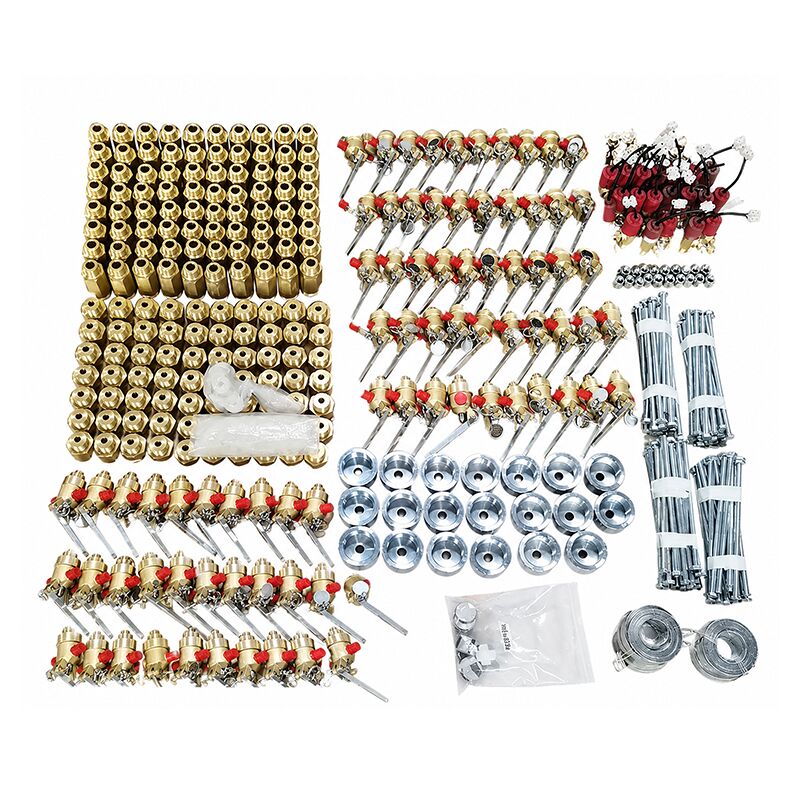
Pipe Network Type of IG100 Automatic Fire Suppression System
Description:
IG100 uses 100% pressurized nitrogen, which accounts for 78% of the atmosphere, as the extinguishing agent. Its ozone depletion potential (ODP) and global warming potential (GWP) are zero. The atmospheric retention time is zero without any adverse effects on the environment. It fully integrates the design concept of the fire-extinguishing system in the new era, so that the product successfully has the function of environmental protection and efficient fire-fighting.
IG100 characteristics: protecting the ecological environment of the earth, safety and hygiene do not interfere with vision, no stain caused by extinguishing agent, durable of fire fighting effect. Nitrogen can be separated from the air and produced from a wide range of sources at a cheap charge.
Combined with extinguishing device and electronic accessories, the whole system can be actuated automatically. It can monitor the situation of protective region through detectors and then it can also start the extinguishing device through solenoid actuator automatically. So the whole system can achieve automation totally. Therefore, it can avoid that there is no one who notice the fire when it happens and it also saves much money for employment to supervise the protective area.
Management of Multiple zones is also in the safe control of the whole system. We can use one system to protect multiple zones through distributing valves. It can make the whole system alternative aiming at different protective zone. Agent can be discharged into where the fire happens. It will be very efficient to put out fire in short time. One thing that need to mention, is that a little room should be prepare to be as storage space for the whole system.
 System components, structure and parameters:
1. Fire extinguishing agent cylinder pack:
Structure: The IG541 mixed gas fire extinguishing cylinder group consists of fire extinguishing agent and storage containers, container valves, safety relief devices, pressure gauges, etc.
|
|
specifications and models
project
|
QMH15/80
|
QMH15/90
|
|
Design pressure (MPa)
|
17.2
|
|
Work pressure (MPa)
|
15
|
|
ambient temperature (℃)
|
0~50
|
|
Fire extinguisher volume V (L)
|
80
|
90
|
|
Outer diameter D (mm) of the fire extinguisher canister
|
Φ279
|
Φ325
|
|
Fire extinguisher height H (mm)
|
1578+73
|
1345+60
|
|
Mixed gas filling volume (m³)
|
12
|
13.5
|
|
Container valve nominal diameter (mm)
|
15
|
|
Container valve outlet thread
|
M30×1.5
|
|
Safety relief pressure (MPa)
|
23±1.15
|
2. Container Valve
2.1 Structural schematic (see figure below)
2.2 Main Perfor
|
model
|
Design Pressure (MPa)
|
Nominal diameter (mm)
|
Connection Thread
|
Valve opening capacity (MP ()
|
|
HRF15/17.2
|
17.2
|
15
|
PZ39
|
< 3(0
|
2.3 Purpose
The container valve is installed on the fire extinguishing agent storage cylinder to seal the extinguishing agent inside. During a fire, the valve is typically opened by actuating gas to release the extinguishing agent for fire suppression.
2.4 Usage and Maintenance Instructions
2.4.1 The container valve features two operating modes: gas activation and manual mechanical operation. Gas activation involves the activation gas driving the piston rod within the actuator cylinder to puncture the working diaphragm of the container valve, thereby opening the valve. Manual mechanical operation requires manual operation of the container valve handle for valve opening; this mode is employed in emergency situations.
2.4.2 The container valve is equipped with a safety diaphragm (with an explosion pressure of 23 MPa) to prevent excessive pressure inside the fire extinguishing agent cylinder by releasing pressure, thereby ensuring cylinder safety. Under normal conditions, the safety diaphragm remains inactive; it may only rupture under abnormal circumstances such as excessively high filling pressure or elevated ambient temperature. If the safety diaphragm ruptures and the cylinder pressure is released, the diaphragm must be replaced immediately, a seal integrity test conducted, and the cylinder refilled with fire extinguishing agent.
When replacing the diaphragm, only diaphragms provided by our company that are identical in model and specifications to the original one and have passed testing must be used; arbitrary substitution is prohibited.
2.4.3 During the filling of fire extinguishing agent, the filling port (as shown in the figure above) should be connected to the gas source; simply loosen the securing screw to proceed with filling. After completion, the securing screw must be tightened before removing the filling connector. Fire extinguishing agent filling shall be performed by qualified professionals.
2.4.4 After the container valve is operated, it must be manually reset and inspected for any abnormalities before resuming use.
3. Air Actuator
3.1 Purpose
The gas actuator is mounted on the container to activate its valve. During a fire, the controller issues a fire suppression command, activating the gas cylinder bank corresponding to the selection valve. This bank releases the activation gas, which opens the respective selection valve. The activation gas then flows through a gas check valve into the actuator pipeline, driving the internal blade to puncture the working diaphragm in the container valve, thereby opening the valve. The valve subsequently releases the fire extinguishing agent to suppress the fire.
During manual activation, remove the safety pin, press the manual handle to puncture the working diaphragm in the container valve, open the valve, and release the fire extinguishing agent to extinguish the fire.
Model _ Structural Diagram and Main Performance Parameters:
|
Air actuator model
|
Container valve connection thread
|
The drive pipeline is threaded.
|
Nominal power
|
Minimum starting force
|
|
HQQ1.2MPa
|
M16*1.5
|
M14*1.5 flanged
|
6.6MPa
|
1.2MPa
|
4. Drive gas cylinder assembly:
Structure: Consists of an air cylinder and an electromagnetic starting valve.
Working Principle: The gas cylinder is a steel pressure vessel filled with high-pressure nitrogen. In the event of a fire alarm, the fire alarm controller outputs a DC-24V current, which activates the electromagnet to open the starting valve, releasing the nitrogen from the cylinder. The released nitrogen then flows through the drive pipeline, opening the container valve. During emergencies, the manual button safety pin can also be removed, allowing immediate activation of the starting valve upon button press.
5. Drive gas cylinder assembly-container valve:
Structure: The manual/electromagnetic valve consists of the main valve body, connection seat, electromagnet, actuator rod, spring, manual button, and manual safety pin.
Working Principle: The manual/electromagnetic valve is installed on the start-up bottle assembly or container valve. When a fire alarm occurs in the protected area, the fire alarm controller outputs a DC 24V current, activating the electromagnet to push the actuator rod and open the container valve or start-up valve. In emergencies, the manual safety pin can be immediately removed, and the button pressed to open the container or start-up valve.


 Your message must be between 20-3,000 characters!